
Karma
The Law of Cause and Effect

This week on the Spirit Vs Science podcast, we leapt into David’s newsletter at Chongism.com on this topic.
While David goes to the practical aspects in the video
In this newsletter, I cover the theoretical aspects in greater depth.
A big disclaimer here is that I am not proficient in Sanskrit, The Sutras nor the Vedic Texts. But I’ve always wondered on the nature of Karma and this writing, It’s a summary of my take home messages.
In my effort to write this, I’ve asked practitioners of Hinduism and Buddhism to help me proofread and I found there are indeed nuances to the subject matter.
*Buddhism has triverged into Mahayana, Theravada and Vajrayana and geographically speaking, practices of the same Theravada Buddhism (Sri Lanka vs South East Asia, for example) may differ because of influences of local religion, brahmanism and Hinduism.
This adds to the varying flavour of nuances on the subject.
As you read on, keep in mind that I take responsibility for all errors and mistakes that you find.
Do light the candle of enlightenment for me at the comments section.! Namaste and Naandri
Let’s Dive in
1) Religions that incorporate Karma
2) Karma being 1 of 5 Natural Laws
3) Types of Karma
4) The Nature of Karma and
5) What is it not

1) Hinduism, Buddhism and Jainism acknowledge and explain the nature of Karma.
2. A total of 5 natural laws (Niyama) - operate in the physical and mental worlds:
Karma being just one of them.
•Seasonal Law(Utu Niyama)
•Biological Law(bija Niyama)
•Natural Law(dhamma Niyama)
•Psychological Law (Citta Niyama)
•Karmic Law( Kamma Niyama)
3. Categories of Karma
• Sanchita Karma, Stock Karma- accumulated karma throughout lifetimes.
impossible to endure and experience all in one lifetime
•Prarabdha Karma -
seed from stock karma that will be planted and will sprout during this lifetime, this present incarnation
•Kriyamana Karma
is new karma that we actively created during this lifetime, can be processed during this lifetime, of which remainder can contribute to stock karma (Sanchita Karma)
4. Nature of Karma
In the language of the harvest, karma is
Sowing good seeds, to reap a good harvest.
If you sow bad seeds, you will reap a bad harvest.
In the language of science, karma is the law of cause and effect:
every cause has an effect.
every Action a Reaction
Moral causation works in the moral realm just as the physical law of action and reaction works in the physical realm.
In speaking to children:
do good and good will come to you, now, and hereafter.
Do bad and bad will come to you, now, and hereafter.
In adages
- People in Glass houses shouldn’t throw Stones
- Do not unto others what you don't want done unto you
- What goes around, comes around
- 己所不欲,勿施于人
- 种瓜得瓜,种豆得豆
- Ada ubi ada talas, ada budi ada balas.
Karma:
- Universal Law:
- Like Gravity: Present whether observed or believed.
- There is no vindictive Lawgiver

5. What it is not.
It is not SEALED FATE.
Man has every possibility to mold his own kamma and thereby influence the direction of his life. We all should take responsibility for what is happening in our life.
Man is not a complete prisoner of his own actions; he is not a slave of his kamma.
Certain experiences in life are the results of previous actions,
but our responses, and therefore outcomes to those experiences are not
predetermined.
For example: If the Prarabdha Karma Lesson Jimmy has to face in this life is
”to learn assertiveness, exerting will”
- in Jimmy’s Day to Day life, a pattern might emerge:
Superiors, bosses, and even people on the street tramples over him and oversteps his boundaries.
Jimmy is forced to take on responsibilities not originally his own at work
or he may get unreasonable, last minute requests from friends and family
He can choose to accept this as unchangeable, but continue to feel frustrated about it.
The alternative approach for Jimmy, is to have agency about this, to learn about healthy boundaries and how to defend his own needs.
If one accepts fate as predetermined and fixed, it might have a disempowering effect. Instead of striving and making changes, it can degenerate into a defeatist attitude of accepting oppression or unjust circumstances as ‘bad karma’.
Past Life vs Generational Karma
- I do not feel qualified to discuss this, one major bugbear that I have is that pure Buddhism does not subscribe to the idea of having a soul.
therefore it complicates the discussions on past-life.
I’ll come back to this when I can get a clearer picture.
But I’ll just place this here.
In certain religious traditions like Vajrayana Buddhism, negative past karma may be "purified" .Reaction of bad kamma can be off-set by meritorious deeds and mind purification. But this may not apply to other denominations which do not subscribe to virtuism, karma can only be diluted.→
I hope this post helps with a bird’s eye view on the subject of Karma!
This 5 minute Video is one of my favourite videos ever.
It helps me find meaning and it gives me the Ooomphs for Paying Kidness Forward,
Scripted, True. But the unscripted version has been playing out in my daily life. <3
Yesterday When I felt extremely low and lost, and needed assurance, the seeds I sowed before, gave me flowers that made my day bearable and I burst through my blocks.


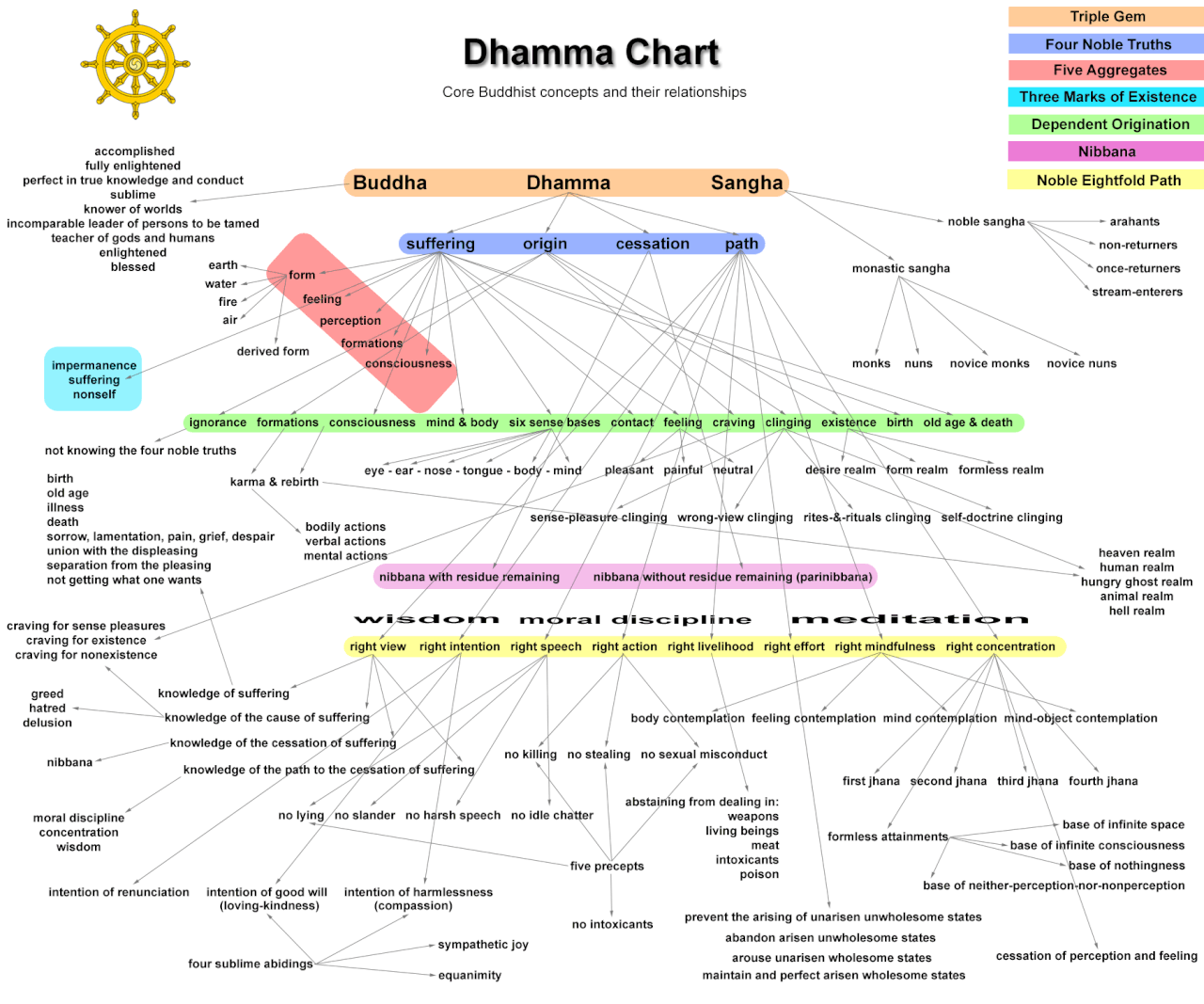
P.S. this is a cool Mind map of Buddhism! Click source for original size

P.P.S.
It is said that
No Matter What your Action Is or Was,
your intention is what matters.
If your action has ulterior motives, Karma will work accordingly
P.P.P.S
Unless we learn the lessons life tries to teach us,
the lessons will repeat itself again and again.
The three steps to transcend groundhog day: Awareness, Analysis and Adaptation.